Two-way light switching: how to control one light from two places
Updated: 2026-10-26
For 230/400 V installations to IEC standards (Europe, UK and most of the world). North America uses different voltages, colours and rules: see the “Around the world” notes.
How it works
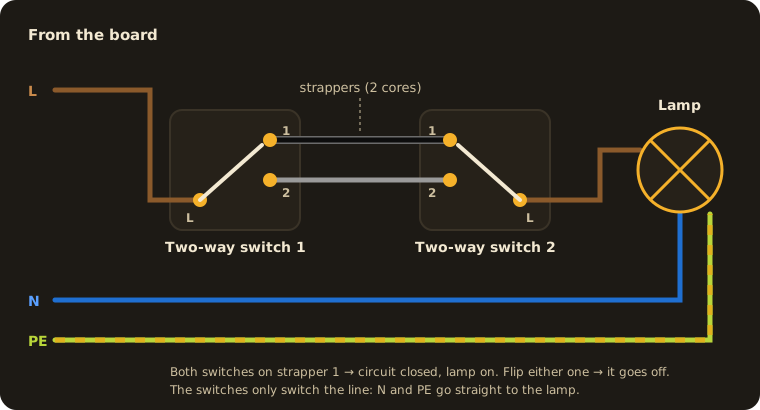
A two-way switch does not simply switch on and off: it changes the line over between two strapper wires. Two of these switches connected by a pair of strappers form a circuit where flipping either switch changes the state of the lamp.
What goes where
| Section | Conductors |
|---|---|
| Board → box → switch 1 (common) | line L (N and PE continue to the lamp) |
| Switch 1 ↔ switch 2 | 2 strappers |
| Switch 2 (common) → lamp | switched line |
| Box → lamp | N and PE directly |
Between the switches you need two strapper cores. Use a cable whose cores carry line colours (for example black and grey), not an ordinary brown, blue and green-yellow cable: see the box below.
Common mistakes
- Neutral taken to a switch: switches only switch the line.
- Common terminal mixed up with a strapper terminal: the light works "backwards" or only in one combination.
- No earth at a metal light fitting.
More than two places
A third and every further switching point is added with an intermediate switch wired into the strappers: see intermediate switching. For four or more points, an impulse relay with push buttons is often simpler.
• UK: called two-way switching; switch terminals are usually marked COM, L1, L2. UK three-core and earth cable has brown, black and grey cores, which fits strappers nicely.
• USA: the same circuit is called a 3-way switch, the strappers are travelers, and the colours follow the NEC.
• Germany: Wechselschaltung.
Did this answer help?