PEN conductor and TN-C-S: where to split it into PE and N
Updated: 2026-10-26
For 230/400 V installations to IEC standards (Europe, UK and most of the world). North America uses different voltages, colours and rules: see the “Around the world” notes.
In a TN-C-S system the combined PEN conductor is split into PE and N at one point only, at the service position or the main distribution board, on the PE bar, and from that point onwards PE and N never join again. You do not split PEN halfway through an installation or in a sub-board. After the split you have a separate PE and a separate N all the way to every socket.
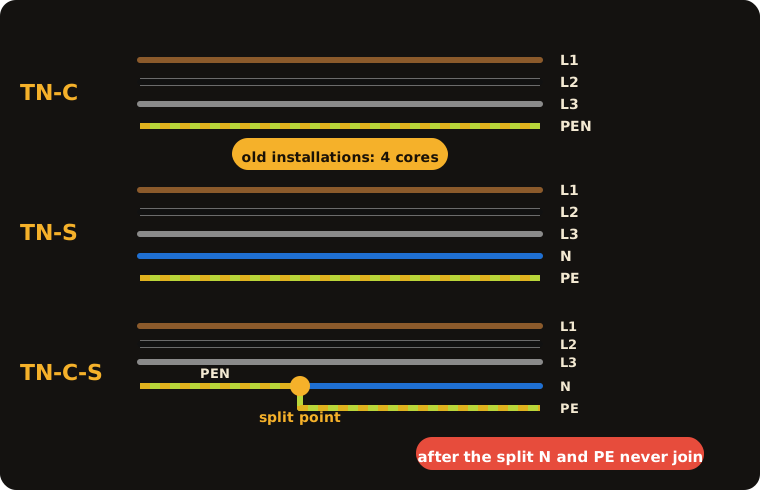
Three letters you must tell apart
- PEN: one conductor doing two jobs, protective (PE) and neutral (N). Found in the TN-C part of a network.
- PE: the protective conductor. It connects exposed metal parts to earth. Normally no current flows in it.
- N: the neutral, the working return path for load current.
What TN-C-S looks like
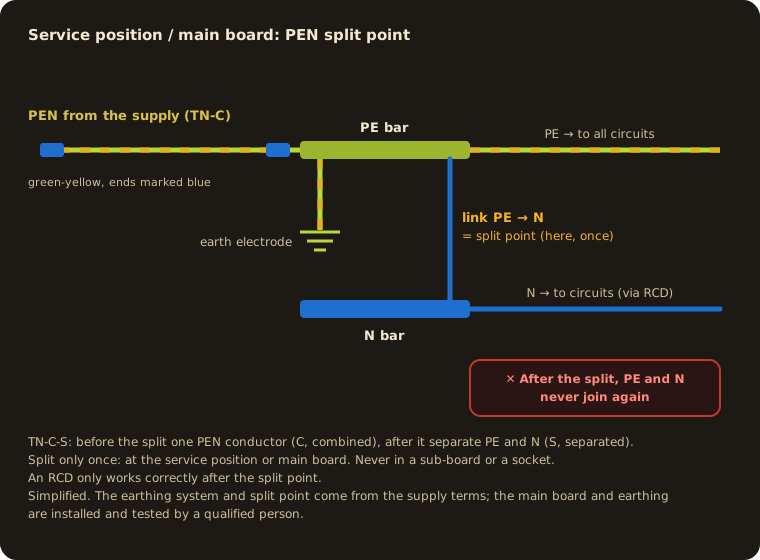
The C (combined) is before the split point, the S (separated) after it. Hence the name TN-C-S.
Rules you never break
- Split only once: at the service position or main board, on the PE bar that is connected to the earth electrode.
- After the split, PE and N never meet again. Joining them in a sub-board or a socket is a serious fault: if the neutral is broken, appliance casings can become live.
- PEN cross-section: at least 10 mm² copper (or 16 mm² aluminium) in fixed installations. Thinner cables are never used as PEN.
- An RCD only works correctly after the split. Before it, N and PE are the same conductor and the RCD cannot see leakage.
How do you know which system you have?
Splitting PEN only makes sense in TN-C, where a combined conductor arrives. In TT the supplier provides a separate neutral and the building has its own earth electrode, independent of the network: there is no PEN to split, and protection relies heavily on RCDs. Do not guess from the cables: the earthing system is stated by your network operator in the connection terms. If you do not have them, ask the operator before planning anything.
Around the world:
• UK: TN-C-S is known as PME (protective multiple earthing), and it is the most common supply. TN-S and TT also exist.
• USA: the same principle under different names: the neutral (grounded conductor) and ground are bonded once, at the main service panel, and kept separate in every sub-panel.
• Norway: many homes are supplied by a 230 V IT system with no neutral conductor at all. The TN-C-S rules on this page do not apply there; IT systems have their own protection rules.
• Germany, Poland and much of Europe: TN-C-S is common in homes.
Note: your earthing system and where the split may be made follow from the connection terms and the state of the installation. The main board and earthing are installed and tested by a qualified person.
Did this answer help?