
What does an RCD do, and which type do you need?
Updated: 2026-10-26
For 230/400 V installations to IEC standards (Europe, UK and most of the world). North America uses different voltages, colours and rules: see the “Around the world” notes.
How it works in one sentence
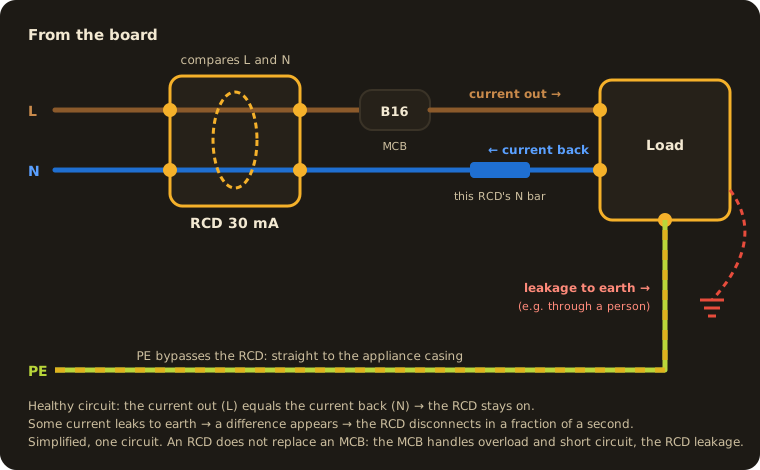
The RCD constantly compares the current going out on the line (L) with the current coming back on the neutral (N). In a healthy circuit they are equal. If part of the current finds another way home, through a person or a damp wall to earth, the two no longer match and the RCD switches off before serious harm is done.
How fast does it trip?
A standard 30 mA RCD must trip within 300 ms at its rated residual current and within 40 ms at five times that current (IEC 61008 / IEC 61009). That is fast enough to stop a shock from becoming fatal in most situations, but you will still feel it.
Sensitivity: which mA for what
| Rated residual current | Typical use |
|---|---|
| 30 mA | Protection of people: sockets, bathrooms, kitchens, outdoor circuits. The home standard |
| 100 to 300 mA | Fire protection against leakage currents, whole sections of an installation |
| 10 mA | Special locations with higher risk; rare in homes |
Types: this matters more than people think
- Type AC: detects only sinusoidal AC leakage. Too limited for modern appliances.
- Type A: also detects pulsating DC leakage. The sensible minimum for a home (washing machines, dishwashers, chargers, power supplies, LED drivers).
- Type F: like Type A plus mixed-frequency leakage, for single-phase appliances with variable-speed drives (some washing machines, heat pumps, air conditioners).
- Type B: also detects smooth DC leakage. For three-phase inverters, some PV systems and EV chargers (many chargers instead use Type A with built-in 6 mA DC detection; follow the charger's manual).
What an RCD will NOT detect
An RCD reacts to a difference between L and N. If you touch line and neutral at the same time (or two phases), the current goes in and comes back through the same circuit: there is no difference, so the RCD does not trip. It protects against leakage to earth, not against every possible contact. It is not a licence to work live.
Good practice
- Press the test button regularly, for example once a month or as the manufacturer recommends. If it does not trip, replace the device.
- Do not put the whole home on one RCD. Split circuits across two or three, so one fault does not kill the fridge and the boiler.
- An RCD does not replace a circuit breaker. The RCD watches leakage; the MCB handles overload and short circuit. You need both, or an RCBO that combines them.
• UK: called an RCD; an RCD and MCB in one device is an RCBO. 30 mA protection for sockets is standard practice.
• USA and Canada: the equivalent for people is a GFCI (ground fault circuit interrupter), which trips at about 4 to 6 mA, much more sensitive than a European 30 mA RCD.
• Germany, Austria: FI-Schalter or RCD.
Did this answer help?