
Why does my RCD keep tripping?
Updated: 2026-10-26
For 230/400 V installations to IEC standards (Europe, UK and most of the world). North America uses different voltages, colours and rules: see the “Around the world” notes.
An RCD trips when it detects that some current is leaking out of the circuit: to earth, through moisture or through a person. The most common causes are a faulty appliance (heating element, washing machine, water heater), damp wiring or an outdoor socket, and a neutral borrowed from another circuit. Less often, the RCD itself is worn out.
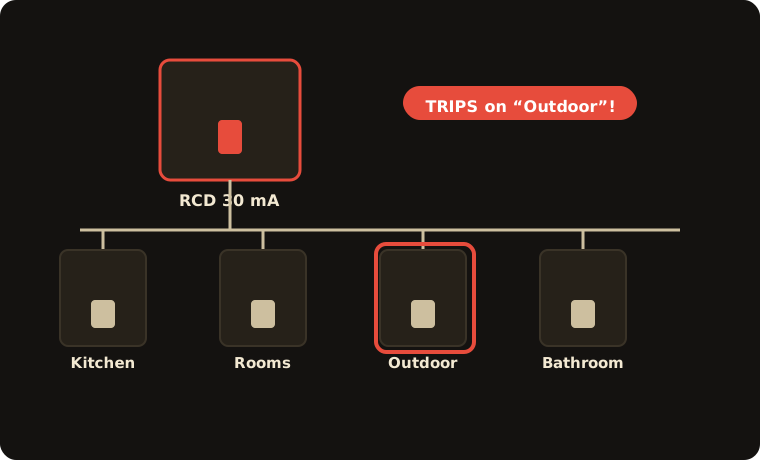
What the RCD is actually detecting
The RCD compares the current going out and coming back. If they differ, the current has found a shortcut. A few tens of milliamps of leakage is enough to trip it. That is not the RCD failing; that is its job.
The most common causes
| Symptom | Likely cause | What next |
|---|---|---|
| Trips when one appliance switches on | failed heating element or insulation inside the appliance (washer, dishwasher, water heater, kettle) | unplug it, have it repaired |
| Trips after rain, in the morning, in humid weather | water in an outdoor socket or garden light, damp wall | dry out, seal, check outdoor boxes |
| Tripped once and will not reset | permanent leakage in the wiring, or neutrals mixed between circuits | electrician: leakage measurement and connection check |
| Trips "by itself" with nothing running | worn RCD, or small leakages from many circuits adding up on one RCD | split circuits across more RCDs, replace if needed |
| Trips during a thunderstorm | surge, operation of the surge protector, damaged insulation | check the SPD and the appliances |
How to find the cause yourself
- Switch off every circuit breaker under that RCD.
- Reset the RCD, then switch the circuits back on one at a time.
- The circuit that trips it is your lead. Unplug everything on that circuit and check whether the appliance or the wiring is to blame.
The "borrowed neutral" trap
A classic after renovations: a light or socket takes its line from one circuit and its neutral from another circuit that sits under a different RCD. Each RCD now sees an imbalance and trips, even though nothing is "leaking". The fix is to make sure every circuit's line and neutral go through the same RCD.
Around the world:
• UK: the same symptoms; "nuisance tripping" often comes from many small leakages on one RCD in a split-load consumer unit. RCBOs on each circuit avoid it.
• USA: the same logic applies to a GFCI that keeps tripping, but GFCIs are much more sensitive (about 5 mA), so long outdoor runs and old appliances trip them more easily.
Important: never bypass or jam an RCD to get the power back. It protects against shock and fire. If it will not reset with everything unplugged, the circuit must be tested by an electrician. Press the test button now and then: if it does not trip, the RCD needs replacing.
Did this answer help?